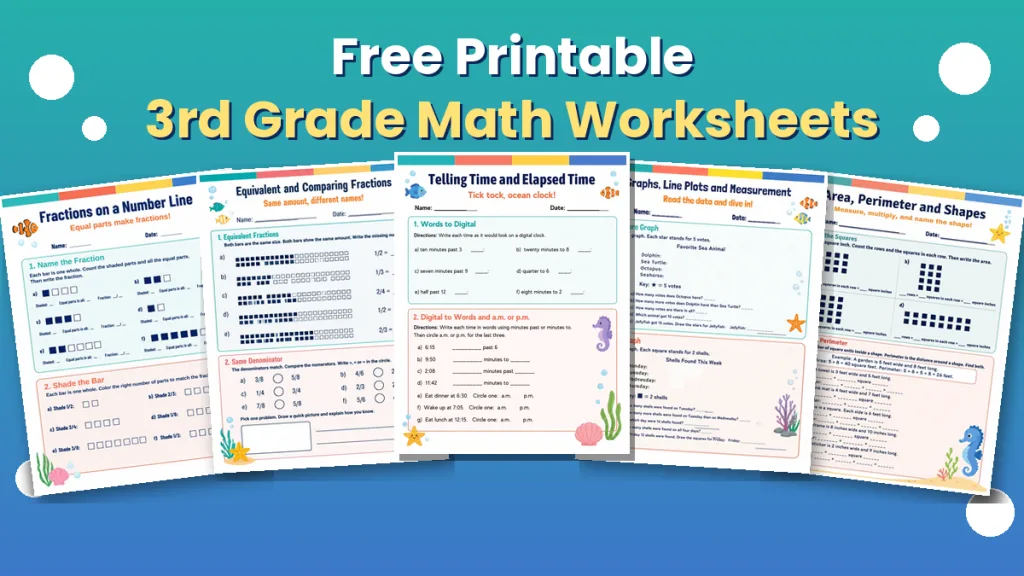
Free printable 3rd grade math worksheets work best when each worksheet targets one skill. The core skills are multiplication, division, fractions, area, and three-digit addition and subtraction.
Look for pages with clear directions, room to show work, and an answer key. A page that mixes ten skills rarely teaches any of them well.
This guide covers twelve types of worksheets a third grader needs, with a sample problem for each. It also shows which skills belong in other grades, so you can skip pages that are too easy or too hard.
Most of these printable activities need only a pencil and a few minutes.
The skill list follows the Common Core State Standards. Many states write their own curriculum, and a district curriculum may order topics differently. Compare this list with your state’s before you print anything.
What Do 3rd Graders Learn in Math?

The Common Core standards for Grade 3 math sort the year’s work under five headings. Those headings are operations and algebraic thinking, number and operations in base ten, fractions, measurement and data, and geometry.
Third grade is the year multiplication and division begin in earnest. Students learn to multiply and divide within 100. By the end of the year, they should know every product of two one-digit numbers from memory.
Fractions also start here. Children work with halves, thirds, fourths, sixths, and eighths on a number line. Area and perimeter join the measurement standards, and decimals wait until 4th grade.
These five headings give teachers a simple outline for lesson plans, whether they run a classroom or a small group. They also work as a checklist for homeschool families. Any educator can use them to find gaps in math skills early.
12 Types of Free Printable 3rd Grade Math Worksheets
Good 3rd grade math worksheets match one standard each, so use the headings below to pick the right sets.
Each type below names the skill, describes what a good page includes, and shows a sample problem. For 3rd grade students, the samples show the format to look for.
1. Multiplication Facts Worksheets
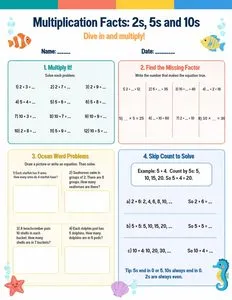
Multiplication is the headline skill of the year. The standards for multiplication and division within 100 ask students to know every product of two one-digit numbers from memory by June.
A good multiplication worksheet covers one fact family at a time. Start with the 2s, 5s, and 10s, then the 3s, 4s, and 9s, and save the 6s, 7s, and 8s for last. The best pages mix plain equations with missing-factor problems.
Sample problem: 7 × 6 = ? Break 6 into 5 + 1. Then 7 × 5 = 35 and 7 × 1 = 7, so 7 × 6 = 42.
2. Skip Counting and Multiplication Chart Worksheets
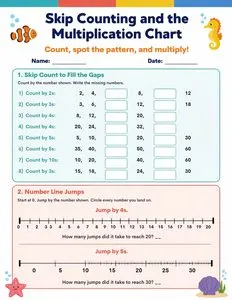
Skip counting is the bridge from adding to multiplying. Children count by 2s through 10s, and the pattern shows what each fact means.
A multiplication chart then helps them spot rules, such as every product in the 5s row ending in 0 or 5.
The standards also ask students to explain patterns in the multiplication table. Good pages use number lines and patterns to complete.
Sample problem: Skip count by 4s: 8, 12, __, 20, __. The missing numbers are 16 and 24.
3. Arrays and Equal Groups Worksheets
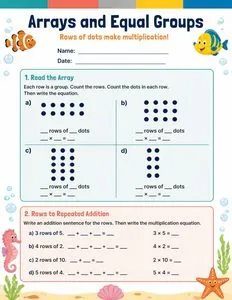
An array arranges objects in rows and columns, and it shows why multiplication works. A child reads 5 × 7 as 5 groups of 7. A 3-by-4 array and a 4-by-3 array hold the same 12 objects, which introduces the commutative property.
Good pages ask children to draw one, write the matching equation, and turn each row into repeated addition. Building with blocks helps, and parents can teach your child math using Legos for hands-on practice.
Sample problem: Draw an array with 4 rows of 6 dots. Write 6 + 6 + 6 + 6 = 24 and 4 × 6 = 24.
4. Division Worksheets
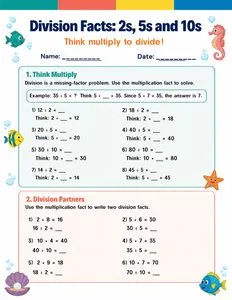
Division is the flip side of multiplication. Students learn to treat each problem as a missing-factor problem, so 56 ÷ 8 = ? becomes 8 × ? = 56. They also learn two meanings: sharing equally and finding how many groups.
Good pages pair each problem with its multiplication partner and add pictures of equal groups.
Sample problem: 42 ÷ 6 = ? Think 6 × __ = 42. Since 6 × 7 = 42, the answer is 7.
5. Multiplication and Division Word Problems
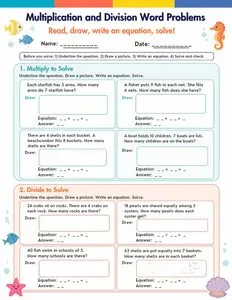
Students solve one-step word problems with multiplication and division within 100. Later they solve two-step problems that mix all four operations. They use a box or a letter for the unknown number and check answers with mental math and rounding.
Careful reading matters most here. Good pages ask children to underline the question, draw a picture, and then write an equation.
Sample problem: A baker packs 8 muffins in each box and fills 6 boxes. She then gives away 9 muffins. How many are left? First, 8 × 6 = 48. Then 48 − 9 = 39 muffins.
6. Rounding and Place Value Worksheets
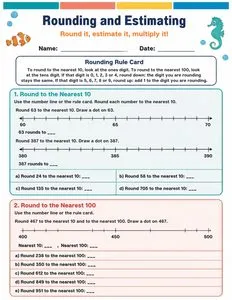
Third graders round whole numbers to the nearest 10 or 100, which helps them estimate before they solve. The base ten standards for Grade 3 also ask them to multiply a one-digit number by a multiple of 10, such as 4 × 30.
Good pages show a number line or a rule card, because rounding rules are easy to forget. They should also mix estimation questions into regular problems.
Sample problem: Round 467 to the nearest 10 and the nearest 100. The nearest ten is 470, and the nearest hundred is 500. For 4 × 30, think 4 × 3 = 12, so the answer is 120.
7. Three-Digit Addition and Subtraction Worksheets
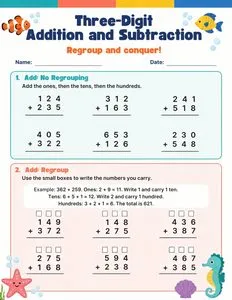
Students add and subtract within 1,000 with fluency. They rely on place value, not just memorized steps. Regrouping is the main challenge.
Strong subtraction worksheets build slowly. They start without regrouping and end with zeros in the middle, such as 405 − 168.
Sample problem: 362 + 259 = ? Add the ones: 2 + 9 = 11, so write 1 and carry 1 ten. Add the tens: 6 + 5 + 1 = 12, so write 2 and carry 1 hundred. Add the hundreds: 3 + 2 + 1 = 6. The total is 621.
8. Fractions on a Number Line Worksheets
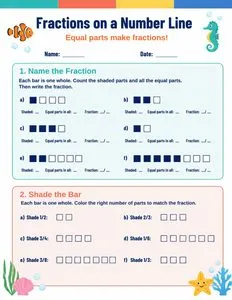
Fractions are new in 3rd grade, and the standards for fractions in Grade 3 limit denominators to 2, 3, 4, 6, and 8. Students learn that a unit fraction such as 1/4 is one of four equal parts of a whole.
They then place each one on a number line from 0 to 1. Each fraction names a count of equal parts.
Good pages use bars, shaded figures, and lines split into equal parts. They also ask children to name what the whole is.
Sample problem: A number line from 0 to 1 is split into 6 equal parts. The point at the fourth mark is at 4/6.
9. Equivalent and Comparing Fractions Worksheets
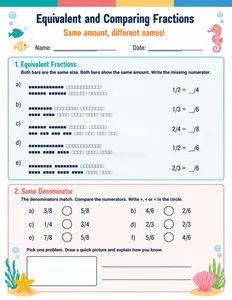
Children learn that two different names can show the same amount, like 1/2 and 2/4. Students find equivalent fractions with models.
They also compare fractions that share a denominator or a numerator, and they write a whole number such as 3 as 3/1.
Good pages ask students to justify each answer with the symbols >, =, and < and a quick drawing.
Sample problem: Compare 3/8 and 5/8. The denominators match, so compare the numerators: 3 < 5, so 3/8 < 5/8. Now compare 1/3 and 1/4. The numerators match, and thirds are bigger pieces than fourths, so 1/3 > 1/4.
10. Telling Time and Elapsed Time Worksheets
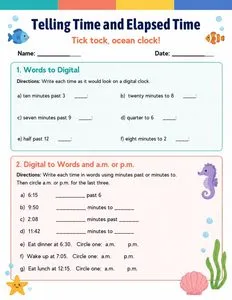
Third graders tell and write time to the nearest minute. They also find elapsed time, which is how many minutes pass between a start and an end. A number line makes those jumps easy to see.
Good pages show analog clocks, digital clocks, and short word problems about real schedules.
Sample problem: A movie starts at 2:45 p.m. and lasts 50 minutes. Jump 15 minutes to reach 3:00. Jump 35 more minutes to reach 3:35. The movie ends at 3:35 p.m.
11. Graphing, Line Plots, and Measurement Worksheets
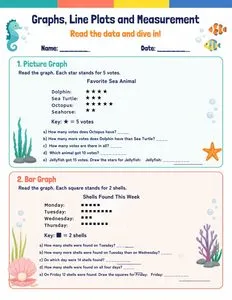
Under the measurement and data standards, students draw scaled picture graphs and bar graphs, where one symbol stands for more than one item.
They also measure lengths to the nearest half inch and quarter inch and show the data on line plots.
Measurement also covers liquid volume in liters and mass in grams and kilograms.
Good pages ask two-step questions, such as how many more votes one bar has than another.
Sample problem: A picture graph uses one star for 5 books. Mystery has 4 stars and Animals has 3 stars. Mystery has 20 books, Animals has 15 books, and 20 − 15 = 5 more books.
12. Area, Perimeter, and Shapes Worksheets
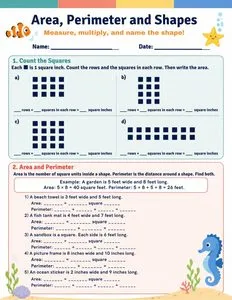
Area is a big idea in 3rd grade. Students find area by counting unit squares, then connect it to multiplication. Perimeter is the distance around a shape, found by adding the side lengths.
Geometry adds quadrilaterals. Children learn that rhombuses, rectangles, and squares are all quadrilaterals.
They also split shapes into equal parts and name each part as a unit fraction, following the geometry standards for Grade 3.
Sample problem: A garden is 5 feet wide and 8 feet long. Its area is 5 × 8 = 40 square feet. Its perimeter is 5 + 8 + 5 + 8 = 26 feet.
Which Worksheets Belong in Other Grades?
Searches for 3rd grade worksheets also surface skills from nearby grades. Decimals, multiplying by two-digit numbers, and remainders belong to the 4th grade math standards.
Save those pages for next year. Many online resources mix grade levels, so check the grade label before you print.
Teachers who group a classroom by skill level can mix grades on purpose.
If your child needs a refresher, step back to free printable 2nd grade math worksheets or math worksheets for 1st grade. Counting pages from kindergarten can also help a child who feels lost.
How to Choose the Right Math Worksheets for Your Child
Quality teaching resources share a few traits. Use this short list when you compare free worksheets or paid ones, and print one page first as a test.
Match the page to one skill. A page on division should not also include clocks and graphs. One topic per page shows you exactly where a child gets stuck.
Check for an answer key. An answer key lets children check their own work. It also saves you time.
Keep sessions short. No standard sets a daily number of pages. One focused page that your child finishes while still alert is a practical starting point.
Pair paper with real objects. Counters, rulers, and a real clock make problems less abstract and give extra practice without more paper.
Teachers can use the same checklist when they pick pages for a classroom set. A class that shares one printable pack also needs an answer key, and resources from the school curriculum should come first.
Frequently Asked Questions
What math should 3rd graders know?
Under Common Core, a third grader should multiply and divide within 100 and know all products of two one-digit numbers from memory. They should also add and subtract within 1,000, work with fractions that have denominators of 2, 3, 4, 6, and 8, and find area and perimeter.
Do 3rd graders learn division?
Yes. Dividing within 100 is a core Grade 3 skill, taught as the opposite of multiplication. Larger numbers and remainders come later, in 4th grade.
How many math worksheets should a 3rd grader do each day?
No standard sets a daily number. One focused page is a practical starting point. Adjust based on your child’s energy and progress.
How can I help my 3rd grader with multiplication at home?
Keep practice short and hands-on. Use counting by 3s and 4s, arrays made from blocks, and a few minutes of fact practice a day. Ask your child to explain how they found an answer, and praise effort.
Where to Start
Pick the skill your child finds hardest and look for a worksheet that teaches only that skill. Check it against the twelve types above and your state’s standards. Once your child feels confident, move to the next type.