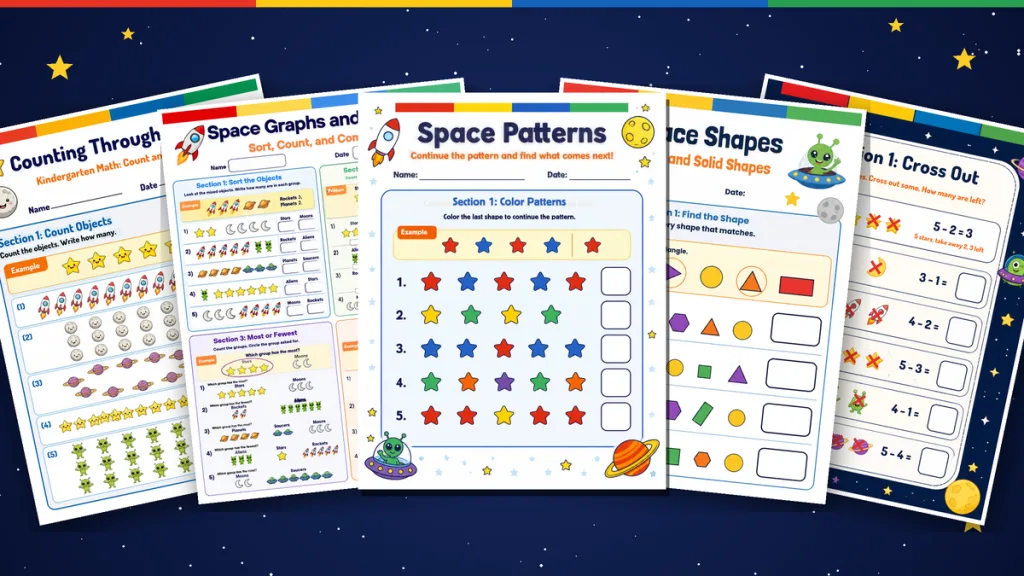
Kindergarten math worksheets work best when each page targets one skill. The core skills are counting, reading numerals, adding and subtracting within 10, and naming shapes.
This guide walks through eight worksheet types a kindergartner needs, with a sample problem for each. It also covers how to choose pages, which skills wait for later grades, and where to go next.
The skill list follows the Common Core State Standards, which describe what students should know by the end of each grade. Check your own state’s standards if they differ.
Counting and Number Worksheets for Kindergarten
Number work fills most of the kindergarten year. Three worksheet types cover it, and each one builds on the last.
1. Counting Worksheets
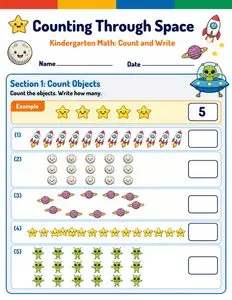
Kindergartners count to 100 by ones and by tens. They also count objects to say how many are in a group, up to 20 objects in a line, array, or circle, and up to 10 objects when the group is scattered.
Good kindergarten counting worksheets use pictures of objects, number lines, and hundred charts with some squares left blank.
A sample prompt reads, “Count the stars and write how many.” Another asks kids to count by tens: 10, 20, __, 40.
2. Number Recognition and Writing Worksheets
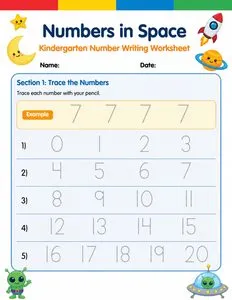
Number recognition means reading a numeral and knowing the amount it stands for. By the end of the year, kindergartners write numerals from 0 to 20 and match each one to a group of objects.
Start with tracing pages, then move to pages where your child writes the number alone. A sample prompt reads, “Draw 8 dots, then write the number 8.”
Publishers label these pages number worksheets or numbers worksheets, and a single page may be called a numbers worksheet. Try all three terms when you search.
3. Missing Numbers Worksheets
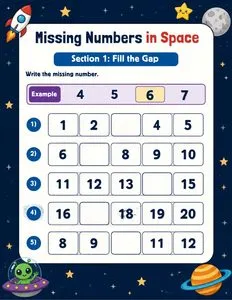
Missing numbers pages ask kids to fill gaps in a count sequence, such as 4, 5, __, 7. The standards ask kindergartners to count forward from a given number, not just from one.
These pages build the habit of knowing what comes next. That habit supports addition later, when your child counts on from the larger number.
Addition and Subtraction Worksheets for Kindergarten
Kindergarten math introduces addition as putting together and adding to. It introduces subtraction as taking apart and taking from. The standards set the limit at 10 and name fluency within 5 as the year-end goal.
Kindergartners should see equations like 5 + 2 = 7. Writing equations is encouraged, but the standards do not require it.
4. Addition Worksheets
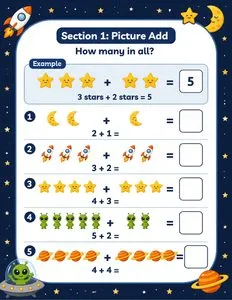
A free kindergarten addition worksheet should use pictures first and equations second. A sample problem shows 3 ducks and 2 more ducks, then asks, “How many ducks in all?”
Strong addition worksheets also include a number line or counters to circle. These tools let your child check an answer by counting.
Kindergartners also learn to find the number that makes 10 when added to any number from 1 to 9. A sample prompt reads, “7 plus what number makes 10?”
Ten frames, which are grids of two rows of five boxes, help kids see the answer.
5. Subtraction Worksheets
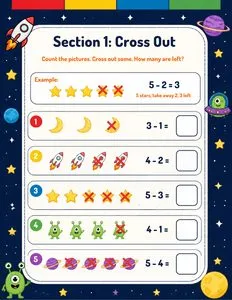
A subtraction worksheet for this age works the same way. Kids cross out pictures to show taking away. A sample problem shows 6 apples, crosses out 2, and asks how many are left.
Kindergarten subtraction worksheets should stay within 10. Start with numbers 5 and under to match the fluency goal, then move up. Pair each equation with a picture so your child sees what taking away looks like.
Related: 9 Printable Math Worksheets for 1st Grade (and What Each One Teaches)
Shape, Pattern, and Graph Worksheets
Geometry is the second critical area in kindergarten math. Kindergartners name shapes, describe where objects sit, and build larger shapes from smaller ones.
6. Shape Worksheets
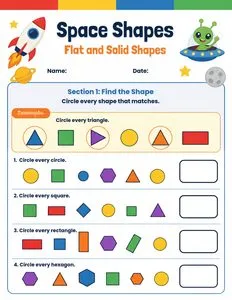
Shape worksheets cover squares, circles, triangles, rectangles, and hexagons, plus solid shapes such as cubes, cones, cylinders, and spheres.
A good shapes worksheet shows each shape at different sizes and turned in different directions. The standards ask kindergartners to name shapes no matter how they are oriented.
A sample prompt reads, “Circle every triangle.”
7. Pattern Worksheets
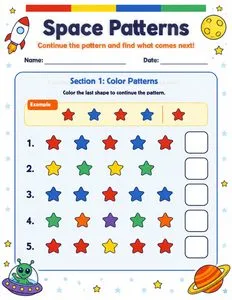
Pattern worksheets ask kids to continue a repeating series, such as red, blue, red, blue, __.
Common Core does not list patterns as a separate kindergarten standard. Some state standards and many classroom programs choose to include them anyway.
Patterns also connect to the Common Core practice of looking for structure. That practice helps kindergartners notice how numbers and shapes repeat.
8. Graph Worksheets
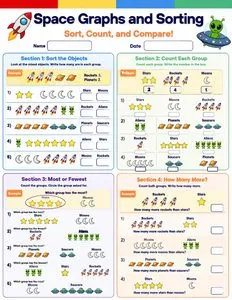
The standards ask kindergartners to sort objects into categories and count how many are in each. A graph worksheet at this level is really a sorting page, with one row or column per category.
Keep each group at 10 objects or fewer. A sample prompt shows a mix of fruit, asks your child to sort it, and then asks, “Which group has the most?”
Related: 12 Free Printable 2nd Grade Math Worksheets (and What Each One Teaches)
What Do Kindergarten Students Learn in Math?
The Common Core State Standards name two critical areas for kindergarten math. The first is representing and comparing whole numbers, starting with sets of objects. The second is describing shapes and space.
The standards also say kindergarten should spend more learning time on numbers than on any other topic. That is why most kindergarten worksheets focus on counting, numeral practice, and simple addition and subtraction.
The work falls under five headings: counting and cardinality, operations and algebraic thinking, number and operations in base ten, measurement and data, and geometry.
You can read each one in the Common Core kindergarten math overview.
Preschool pages often cover earlier steps, such as matching, sorting, and counting small groups. Kindergarten pages push further, with counting to 100, writing numerals to 20, and number stories within 10.
How to Choose Kindergarten Worksheets for Your Child
A kindergarten math worksheet only helps when it matches the skill your child is practicing. Pick a kindergarten worksheet that targets one skill, because a page that mixes counting, shapes, and subtraction makes it hard to tell which skill caused a mistake.
Free kindergarten math worksheets vary in quality, so check each page against the skill list above.
Free printables are easy to find, but easy to find does not mean well made. Look for these features:
- One clear skill per page
- Large print, clear pictures, and room to write
- Numbers within kindergarten limits: 20 for counting objects and 10 for addition and subtraction
- An answer key for adults
- A label that says kindergarten, not preschool or another grade level
Check the directions too. Short, plain directions that a child can hear once work better than long ones. If your child cannot read yet, read the prompt aloud and let your child answer by circling or drawing.
Interactive worksheets that ask kids to cut, glue, color, or place counters on the page give young learners a hands-on way to show an answer.
A printable worksheet is easy to reuse. Slide the page into a plastic sleeve and let your child write with a dry-erase marker. Printables also let you repeat a skill as often as your child needs.
Keep sessions short. One focused page a few times a week, paired with everyday counting like setting the table, makes steady math practice.
Hands-on math activities, such as sorting laundry or counting stairs, give young children real objects to count before they move to pictures.
Good kindergarten math resources pair worksheets with play. Short, regular sessions build early math skills without pressure.
Related: 12 Free Printable 3rd Grade Math Worksheets (and What Each One Teaches)
Which Skills Belong in Later Grades?
Many printables labeled kindergarten stray into skills from a higher grade level. Formal place value is one example of a skill that belongs to a later grade. Kindergartners only see the numbers 11 to 19 as ten ones plus some more ones.
Measurement stays informal in kindergarten. Kids compare two objects and say which is longer, shorter, heavier, or lighter. Formal measuring with units and rulers grows in later grades.
If a page asks for sums above 10 or two-digit place value, it is aimed at older students, even when the cover says kindergarten. Later grade worksheets add those skills step by step. Pages labeled preschool sit below kindergarten and review earlier steps.
Kindergarten learners who finish early can explain an answer aloud or build the same problem with blocks.
Related: 8 Free Printable 4th Grade Math Worksheets (and What They Teach)
Frequently Asked Questions
What should a 5 year old know by the end of kindergarten?
Under Common Core, a kindergartner should count to 100 by ones and tens and write numbers from 0 to 20. They should also compare two numbers within 10, add and subtract within 10, and name basic shapes. Fluency within 5 is the stated goal for addition and subtraction.
How many kindergarten math worksheets should my child do each day?
No standard sets a daily number. One focused page is a practical starting point. Adjust based on your child’s energy and progress.
How do I teach my kindergarten math?
Teach kindergarten math in short, hands-on sessions of 10 to 15 minutes. Start with counting real objects like blocks or snacks, then move to worksheets once your child understands the idea. Focus on one skill at a time, such as counting, shapes, or patterns, and practice it daily through play and everyday routines
What math should kids know before kindergarten?
Kids should be able to count to 10 (or higher), recognize numbers 1 to 5, and count small groups of objects accurately before kindergarten. They should also name basic shapes like circles, squares, and triangles, sort objects by color or size, and understand words like more, less, big, and small. Skills build through play, not drills.
Where to Start
Pick the skill your child finds hardest and look for a page that teaches only that skill. Check it against the eight types above and your state’s standards. Once your child gains confidence, move to the next type.
If your child feels unsure, go back one step. Try counting groups of 5 before 20, or sums within 5 before 10. A page your child can finish builds the confidence to try the next one.
Want more? Browse our Printable Worksheets collection for guides that break down what each page teaches at every grade!