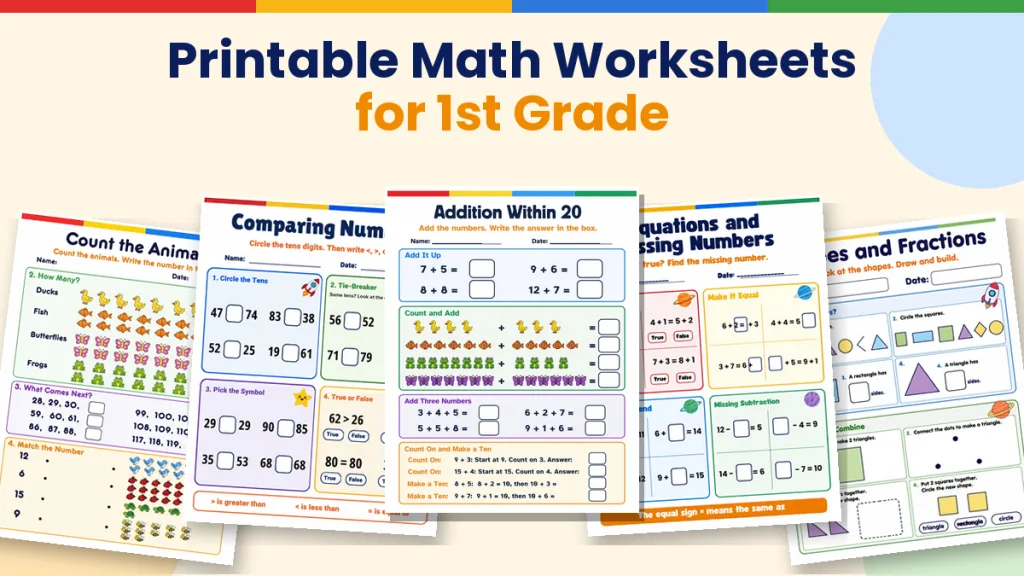
Printable math worksheets for 1st grade work best when each page targets one skill. The core skills are adding and subtracting within 20, place value, measurement and time, and shapes.
Look for pages that use pictures to support the numbers and include an answer key.
This guide walks through nine worksheet types a first grader needs, with a sample problem for each. It also covers skills that belong in later grades and how to choose pages that fit your child.
The skill list follows the Common Core State Standards, so check your own state’s standards if they differ.
What Do 1st Graders Learn in Math?

The Common Core State Standards describe four critical areas for Grade 1 math. First, children build strategies for adding and subtracting within 20.
Second, they learn place value by grouping numbers into tens and ones.
Third, they measure length with units, and fourth, they put shapes together and take them apart.
The standards sort this work under four headings: operations and algebraic thinking, number and operations in base ten, measurement and data, and geometry.
Despite the name, algebraic thinking in first grade means working with equations and number relationships. Children do not solve for x yet.
Many states write their own standards. Use these headings as a starting point, then compare them with your state’s list.
9 Types of Printable Math Worksheets for 1st Grade
Each type below names the skill, describes what a good page includes, and shows a sample problem. The samples show the format to look for.
1. Counting and Number Sense Worksheets
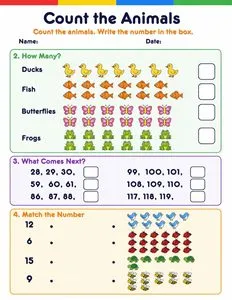
First graders count to 120, starting from any number below 120. They also read and write those numerals and match them to groups of objects.
Good pages use number charts with gaps, groups of objects to count, and “what comes next” prompts.
Sample problem: Fill in the missing numbers: 47, 48, __, 50, __. A number line strip along the top of the page helps children see how numbers sit in order.
2. Addition Within 20 Worksheets
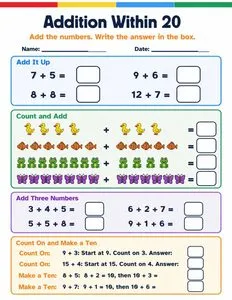
Addition within 20 is the main skill of the year. The standards expect fluent addition and subtraction within 10, plus strategies such as counting on and making a ten.
Good pages mix plain equations with picture problems and a few three-number sums.
Sample problem: 8 + 6 = ? Split 6 into 2 and 4. Then 8 + 2 = 10, and 10 + 4 = 14.
3. Subtraction Within 20 Worksheets
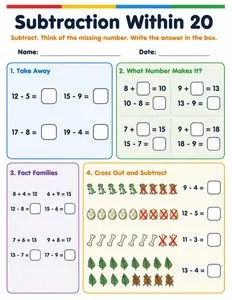
Subtraction pages should connect back to addition. The standards ask children to treat subtraction as a missing-addend problem, so 10 − 8 becomes “what number plus 8 makes 10?” Fact families, such as 8 + 4 = 12 and 12 − 8 = 4, reinforce that link.
Sample problem: 13 − 4 = ? Take away 3 to reach 10. Then take away 1 more, and 10 − 1 = 9.
4. Word Problem Worksheets
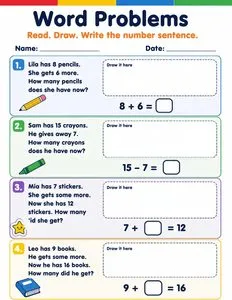
Word problems cover adding to, taking from, putting together, taking apart, and comparing. The unknown number can land in any position, not just at the end.
Good pages keep sentences short and leave room for children to draw the problem.
Sample problem: Mia has 7 stickers. She gets some more. Now she has 12 stickers. How many did she get? The equation is 7 + __ = 12, so the answer is 5.
5. Place Value Worksheets
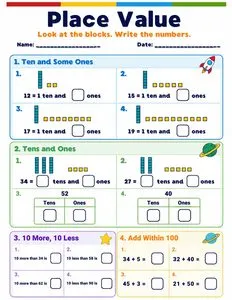
Place value starts with seeing 10 as a bundle of ten ones. Children then see 11 to 19 as a ten plus some ones. Good pages show tens and ones with drawings, blocks, or a simple chart.
Children also find 10 more or 10 less than a two-digit number without counting. Later in the year, they add within 100, such as 34 + 5 or 32 + 40. Sample problem: 34 = __ tens and __ ones.
6. Comparing Numbers Worksheets
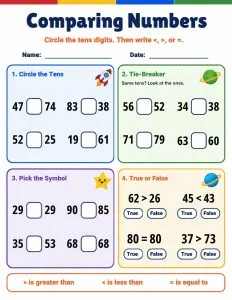
First graders compare two two-digit numbers with the symbols >, =, and <. The tens digit decides the comparison first, and the ones digit breaks a tie.
Good pages ask children to circle the tens digits before they choose a symbol.
Sample problem: 47 __ 74. Since 4 tens is less than 7 tens, the answer is 47 < 74.
7. Equations and Missing Number Worksheets
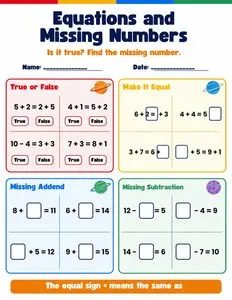
The standards ask children to understand what the equal sign means. A strong page asks whether equations are true or false, such as 5 + 2 = 2 + 5 (true) and 4 + 1 = 5 + 2 (false).
It also asks children to find the unknown number in an addition or subtraction equation.
Sample problem: 8 + __ = 11. The missing number is 3.
8. Time, Measurement, and Data Worksheets
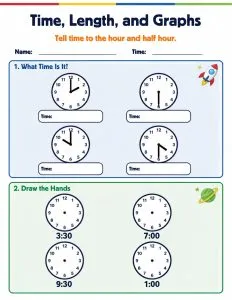
First graders tell time to the hour and half hour on analog and digital clocks. They also order three objects by length and measure with units laid end to end, such as paper clips or cubes.
Rulers and standard units like inches begin in Grade 2, so first-grade pages should stick to objects.
For data, children sort items into up to three categories and answer questions about the totals.
A good picture graph page asks how many are in each group and how many more one group has than another.
Sample problem: Draw the hands on the clock to show 3:30.
9. Shapes and Fractions Worksheets
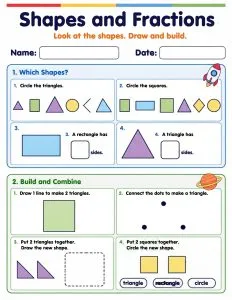
Children learn which attributes define a shape and which do not. A triangle is closed and has three sides, but its color and size do not matter.
They also build rectangles, squares, and triangles, combine shapes into new ones, and split circles and rectangles into halves and fourths.
Sample problem: Draw one line to split this rectangle into two equal halves. Then color one half.
Which Math Skills Wait Until Later Grades?
Many “1st grade” bundles include skills that the standards place in later grades. Skip counting by fives and hundreds first appears in Grade 2, along with money problems that use coins and dollar bills.
Telling time to the nearest five minutes also belongs to Grade 2.
Multiplication has a similar timeline. Grade 2 introduces equal groups and arrays as groundwork, and formal multiplication and division start in Grade 3.
If your first grader struggles with a multiplication page, the cause is likely grade placement, not ability.
How to Choose Printable Math Worksheets for 1st Grade
The IES practice guide on helping struggling elementary math students lists six recommendations: systematic instruction, mathematical language, visual representations, number lines, word problems, and timed activities.
It targets students who struggle, but several of those ideas shape a good worksheet. Use this checklist when you compare options.
- One skill per page, so your child can focus.
- Pictures, drawings, or counters that show the math.
- Large, clear numbers with room to write.
- Consistent math words, such as “more,” “fewer,” and “equal.”
- An answer key on a separate page.
- Skills that match your state’s Grade 1 standards.
How to Use Worksheets at Home Without Burnout
Start with one page a day, and stop while your child still feels good about it.
Pair each page with something hands-on, such as counting buttons or building shapes from blocks. Timed activities appear on the IES list too, so a quick fact game can help.
Keep it light by asking your child to beat their own time.
A steady slot in the day makes practice easier to keep up. These visual daily routine chart ideas for kids show how to place a short math block in the schedule.
Small rewards can help too, and these printable reward chart templates make progress easy to see.
Themed pages can also hold a young child’s attention. For a themed option, browse our community helper worksheets for preschool through 1st grade.
A Simple Weekly Rotation
Rotating worksheet types keeps practice fresh. Here is one way to spread the nine types across a school week. It is a suggestion, not a standard, so adjust it to your child.
- Monday: Addition within 20.
- Tuesday: Subtraction within 20.
- Wednesday: Place value or comparing numbers.
- Thursday: Word problems.
- Friday: Time, measurement, shapes, or data.
If one day’s page feels too easy, move on early. If it feels too hard, repeat it with objects before you try another page.
Frequently Asked Questions
What math should a 1st grader be able to do?
Under Common Core, a first grader should add and subtract within 20 and know facts within 10 fluently. They should also count to 120, understand tens and ones, and compare two-digit numbers. Telling time to the hour and half hour completes the core list.
Do 1st graders learn multiplication?
Not under Common Core. Equal groups come in Grade 2, and multiplication begins in Grade 3. Your state may use a different sequence, so check its standards.
How many worksheets should a 1st grader do each day?
No standard sets a daily number. One focused page is a practical starting point, and you can adjust based on your child’s energy and progress.
How do I help my 1st grader with math?
Keep practice short and hands-on. Use counters, coins, or snacks to show addition and subtraction within 20, and practice making ten. Turn daily moments, like setting the table, into counting problems. Ask your child to explain how they got an answer, and praise effort. Add one focused worksheet a few times a week.
Where to Start
Pick the skill your child finds hardest and look for a page that teaches only that skill. Check it against the nine types above and your state’s standards. Once your child gains confidence, move to the next type.