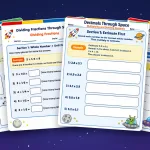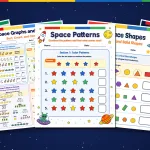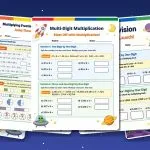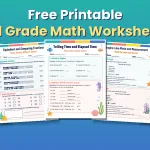
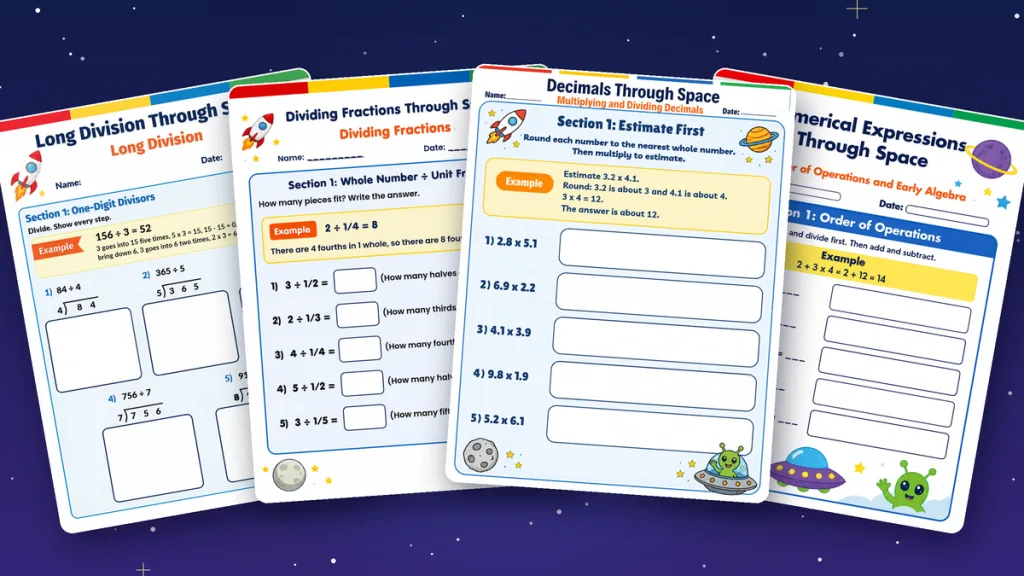
The best 5th grade math worksheets match what your child is learning right now. In fifth grade, that means fractions, decimals, multi-digit multiplication, and long division.
Pick a page that targets one skill, and keep each session short.
This guide covers the major topics in 5th grade math and what good practice looks like for each. It is written for parents and teachers of 5th graders who want practice that builds real understanding.
It also shows how to spot a weak page before you print it.
What 5th Grade Math Covers

Fifth grade is a turning point. Students stop learning basic facts and start using them in bigger, multi-step problems. Fractions get harder, decimals enter the picture, and division grows to larger numbers.
The Common Core grade 5 math standards group the year into a few main areas. Students work on place value and decimals, operations with fractions, and writing expressions.
They also study volume and plot points on the coordinate plane.
Grade 5 math builds on the arithmetic students learned in earlier years. Most 5th grade math topics fall into one of those areas, which gives you a simple way to sort practice.
If a page does not fit one of them, it may not match what your child’s class is doing.
Multiplication and Division
Fluent multiplication and division are the base for almost everything else this year. A student who stalls on a multiplication fact will stall again on fractions and decimals.
Good practice here saves time later.
Multi-Digit Multiplication
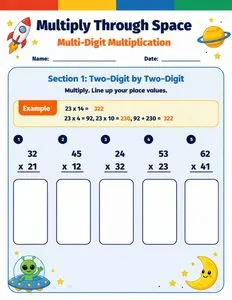
Students learn to multiply large numbers using the standard algorithm. A problem like 346 times 28 asks them to line up place values and carry correctly.
Each step is simple, but the steps add up fast.
A strong multiplication worksheet starts with two-digit by two-digit problems. It then moves to three-digit by two-digit problems.
Look for pages that mix in a few word problems so kids see why they multiply.
Watch for one common mistake. Students often forget the placeholder zero on the second line. A worked example at the top of the page helps them check that step.
Long Division
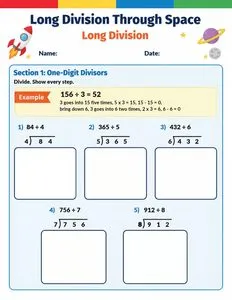
This is the hardest part of the year for many kids. It combines estimation, multiplication, and subtraction in one problem. Students divide numbers with up to four digits by two-digit divisors.
Start with one-digit divisors if your child feels shaky. Move to two-digit divisors once the routine feels automatic. The page should leave room to show each step, not just the final answer.
Remainders matter too. Good practice includes problems that end evenly and problems that do not.
Ask your child to explain what a remainder means in a short word problem.
Fractions and Mixed Numbers
Fractions take up a large share of the year. Students add, subtract, multiply, and divide them. They also work with mixed numbers, such as 2 and 3/4, which blend a whole number with a fraction.
Pages on mixed numbers should include adding and subtracting, since kids often regroup incorrectly. Ask them to rewrite each answer in simplest form.
Equivalent Fractions and Unlike Denominators
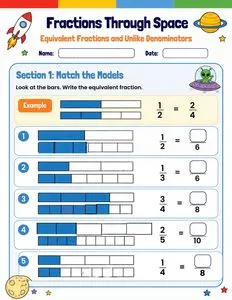
Adding fractions with different denominators depends on equivalent fractions. To add 1/2 and 1/3, students first rewrite both as sixths. That step is the heart of the skill.
Good fractions worksheets show models, such as bars or circles, beside the numbers. Pictures let students see that 1/2 and 3/6 name the same amount.
Pure number drills come later, once the idea makes sense.
Multiplying Fractions
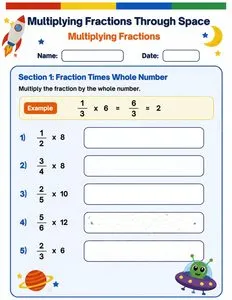
Multiplying fractions is easier than adding them, because no common denominator is needed. Students multiply the tops, then multiply the bottoms. A problem like 2/3 times 3/4 becomes 6/12, which simplifies to 1/2.
The harder part is understanding what the answer means. Multiplying by a fraction less than one makes the result smaller. Area models and short word problems, such as finding half of 3/4 of a pizza, make that clear.
Dividing Fractions
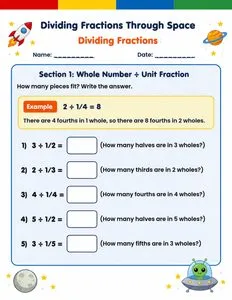
In 5th grade, dividing fractions stays limited. Students divide a whole number by a unit fraction, or a unit fraction by a whole number. For example, they ask how many 1/4-cup scoops fit into 2 cups.
Use pictures and real situations for this topic. Cooking, sharing, and measuring all work well. The flip-and-multiply rule comes later, so avoid pages that push it too early.
Decimals
Decimals link the number system to money, measurement, and later science work. Students read, write, compare, and round decimals to the thousandths place. Then they use all four operations with them.
Place Value and Rounding
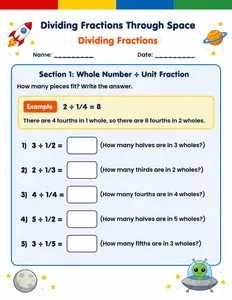
Before any calculation, students need to know what each digit is worth. In 4.382, the 3 stands for three tenths and the 8 for eight hundredths. Writing numbers in expanded form builds that sense.
Comparing decimals is a second key step. Many students think 0.45 is larger than 0.5 because 45 is larger than 5. Number lines and place value charts clear that up, and so does lining up the decimal point before comparing.
Multiplying and Dividing Decimals
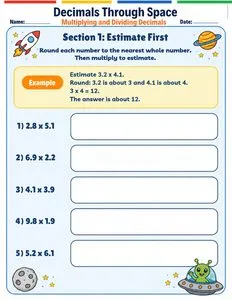
To multiply decimals, students first multiply as if the numbers were whole. They then place the decimal point in the answer. Estimating before multiplying decimals, such as seeing that 3.2 times 4.1 is close to 12, helps them catch errors.
Dividing decimals asks for more care. When students divide decimals, they must track the decimal point and often add zeros to finish.
Choose decimals worksheets that start with whole-number divisors and move up gradually.
Money makes an ideal setting. Splitting a 12.60 dollar bill among four people is a real division problem with a decimal answer. Real situations keep the work meaningful.
Numerical Expressions and Early Algebra
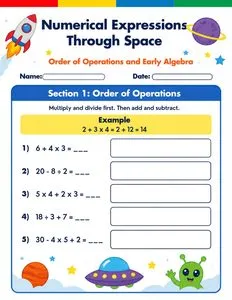
Students also learn to read and write numerical expressions. They use parentheses and brackets, and they follow the order of operations. A problem like 3 times (4 plus 5) differs from 3 times 4 plus 5.
This is the first taste of algebra. A good algebra worksheet at this level does not use letters. It asks students to write an expression from words, such as “add 8 and 7, then multiply by 2.”
Check that the page includes both evaluating and writing expressions. Evaluating alone becomes a rule to memorize rather than an idea to understand.
How to Choose the Right Worksheet
Not every page deserves a spot on your printer. A printable math worksheet works best when it passes a short checklist.
- One focus per page. A page that mixes six topics hides what your child needs.
- A worked example. Students can look back at the model when they get stuck.
- Room to show work. Cramped pages push kids to skip steps.
- An answer key. Parents and teachers can check quickly and spot patterns.
- A mix of problem types. Include some word problems, not only bare calculations.
Look for 5th grade worksheets that match your child’s level. If a student breezes through a page, move on. If they miss half the problems, step back to an easier topic and rebuild.
Printable worksheets make that switch quick, since you can print the next page in seconds.
How to Make Worksheet Practice Stick
Short, regular practice beats long, rare sessions. Ten to fifteen minutes a few times a week works better than one hour on Sunday. Kids tire quickly when a page feels endless.
Review mistakes together. Ask your child to talk through a missed problem out loud. Often they find the error themselves, and that builds math skills that last.
Steady practice also pays off on math tests, where speed and accuracy both count.
Mix in games and real tasks. Doubling a recipe teaches scaling by fractions. Comparing prices teaches decimals. Pages then reinforce math concepts rather than replace real-world use.
Praise effort and strategy, not just right answers. A student who says “I tried a new way” is learning more than one who guesses fast.
Fill Gaps With Earlier Grade Practice
Most trouble in 5th grade traces back to a gap from an earlier year. A student who struggles with division may still be shaky on basic multiplication.
A student who struggles with fractions may need to revisit the previous year.
That is why it helps to keep practice from several levels on hand. Printable grade mathematics worksheets from earlier years also work as quick warm-ups.
Milowe Kids offers printable math pages for each grade, and each explains what its page teaches:
- Start with the 4th grade math worksheets to review multiplication, division, and fraction basics.
- Use the 3rd grade math worksheets and free printables to firm up multiplication facts.
- Try the 2nd grade math worksheet collection for place value practice and subtraction worksheets with regrouping.
- Browse the printable math worksheets for 1st grade for number sense and early addition.
- Open the kindergarten math worksheets for counting and number recognition.
Pick the grade that matches the gap, print a page, and watch for progress. Once the older step feels solid, return to grade 5 math with more confidence.
FAQs
What math do you learn in 5th grade?
Fifth graders learn multi-digit multiplication, long division, decimals, and fractions. They add and subtract fractions with unlike denominators, multiply fractions, and divide using unit fractions. They also study place value to the thousandths, numerical expressions, volume, and graphing points on the coordinate plane. These skills prepare kids for middle school math.
What is the hardest math in 5th grade?
Many kids find long division and fraction operations hardest. Long division combines estimation, multiplication, and subtraction in one problem, so one slip changes the answer. Adding fractions with unlike denominators and dividing decimals also cause trouble. Short, focused practice on one skill at a time usually works better than mixed review.
What should a 5th grader know by the end of the year in math?
By the end of fifth grade, kids should multiply multi-digit whole numbers fluently and divide up to four-digit numbers by two-digit divisors. They should add, subtract, multiply, and divide decimals to the hundredths, work with fractions and mixed numbers, evaluate numerical expressions, and find the volume of rectangular prisms.
Does grade 5 have algebra?
Not formally. Fifth grade introduces algebra thinking without variables. Students write and evaluate numerical expressions with parentheses and brackets, and graph number patterns as ordered pairs on the coordinate plane. Formal algebra with letters and equations begins in 6th grade, so these skills are the foundation.
Where This Year’s Math Leads
The topics in this year carry far beyond elementary school. Fractions, decimals, and whole numbers all return in middle school ratios, percents, and equations. Even adult tests such as GED math lean on the same number sense.
Students who master grade 5 math are ready for those ideas. The goal is not speed for its own sake. It is effortless math fact recall, so kids can spend their thinking on new problems.
Start with one topic from this list, choose a focused page, and keep each session short. Your child will gain ground with every small win.