The best 4th grade math worksheets each focus on one skill. In fourth grade, that means multi-digit multiplication, long division, fractions, and decimals. A page that mixes all four rarely teaches any of them well.
This guide walks through the topics fourth grade students practice most, with a sample problem for each. You will also see how to tell a useful math worksheet from one that only fills time.
Every topic follows the national math standards, so you can match it to your child’s class.
Many states write their own curriculum, and a district may teach topics in a different order. Compare this list with your state’s before you print anything.
What Do 4th Graders Learn in Math?

The Common Core standards for Grade 4 math name three critical areas for the year. The first is multiplying and dividing larger whole numbers.
The second is fraction equivalence and basic fraction operations. The third is classifying shapes by their lines, angles, and symmetry.
Students also stretch place value up to 1,000,000. They work with factor pairs, measure angles, and read data. The first two areas take the most practice, so they are where worksheets help most.
Children entering this grade should already know their basic multiplication facts. If those feel shaky, start with these free printable 3rd grade math worksheets for multiplication and division, then circle back here.
Multi-Digit Multiplication Worksheets
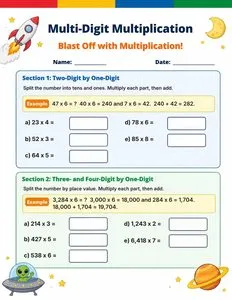
Multiplication is the biggest topic of the year. Fourth graders multiply numbers up to four digits by a one-digit number. They also multiply two 2 digit numbers, such as 47 × 36.
Sample problem: 47 × 36 = ?
The answer is 1,692. Split 36 into 30 and 6, then work out 47 × 30 = 1,410 and 47 × 6 = 282. Add the two parts to finish.
Sample problem: 3,284 × 6 = ?
The answer is 19,704. Multiply 3,000 × 6 = 18,000, then 284 × 6 = 1,704, and add them.
Better pages also ask kids to draw an area model or write partial products. Those steps show why the method works, not just how to run it. That understanding carries over when the numbers get bigger.
Mental Multiplication Practice
Mental multiplication is a small but useful add-on. It lets a child estimate and check answers without paper. To find 5 × 48, multiply 10 × 48 to get 480, then cut that in half to get 240.
Try three or four of these as a quick warm-up before the written problems. Short mental math drills also help kids spot answers that cannot be right.
Long Division Worksheets and Remainders
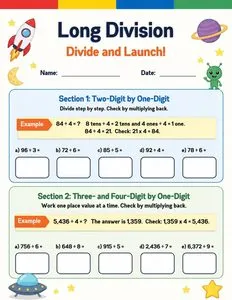
Students divide numbers with up to four digits by a one-digit number. They also learn to read a remainder in context. Dividing 47 by 6 gives 7 with a remainder of 5, and a word problem decides whether that leftover matters.
Sample problem: 5,436 ÷ 4 = ?
The answer is 1,359. Check it by multiplying back: 1,359 × 4 = 5,436. Teaching kids to check division with multiplication catches many mistakes.
Look for pages that show the steps in a clear layout at first. Once a child is steady, pages with no step boxes make better practice.
Fractions Worksheets for Fourth Grade
Fractions are the second big area, and they trip up many kids. Each page should stay on one idea. Grade 4 also limits the denominators to 2, 3, 4, 5, 6, 8, 10, 12, and 100, so pages with a denominator of 7 or 9 go beyond the standards.
Equivalent Fractions
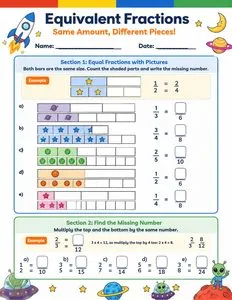
Equivalent fractions name the same amount using different-sized pieces. Fraction equivalence is the idea behind comparing and adding fractions later in the year.
Sample problem: 2/3 = ?/12
The answer is 8. The bottom number grew by 4 (3 × 4 = 12), so the top number must grow by 4 as well (2 × 4 = 8).
Comparing fractions with different denominators is also on the list. To compare 3/4 and 5/8, rewrite 3/4 as 6/8. Since 6/8 is larger than 5/8, 3/4 is the greater fraction.
Adding and Subtracting Mixed Numbers
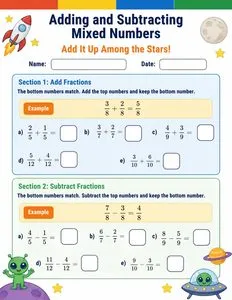
Kids add and subtract fractions that share a denominator, including mixed numbers.
Sample problem: 2 3/8 + 1 5/8 = ?
The answer is 4. The whole numbers give 2 + 1 = 3, and the fractions give 3/8 + 5/8 = 8/8, which equals 1. Then 3 + 1 = 4.
Multiplying Fractions by Whole Numbers
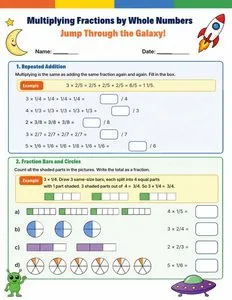
This is as far as fourth grade goes with multiplying fractions. Kids multiply a fraction by a whole number, often by thinking of repeated addition. Learning to multiply fractions by other fractions waits until fifth grade.
Sample problem: 3 × 2/5 = ?
The answer is 6/5, or 1 1/5. It is the same as 2/5 + 2/5 + 2/5.
A good fractions worksheet includes pictures such as bars, number lines, and circles. Strong fraction worksheets show those models before they ask for pure computation.
Decimal Worksheets for Tenths and Hundredths
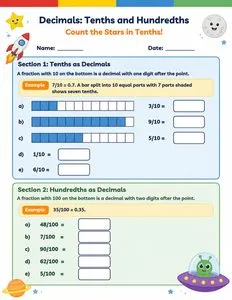
Fourth graders learn decimal notation for tenths and hundredths. They link fractions with denominators of 10 and 100 to decimal numbers. For example, 7/10 is 0.7, and 35/100 is 0.35.
Sample problem: 3/10 + 4/100 = ?
The answer is 0.34. Rename 3/10 as 30/100, then add 30/100 + 4/100 = 34/100.
Comparing is the other main task. Which is larger, 0.4 or 0.38? Write 0.4 as 0.40, and it is clear that 0.40 is greater than 0.38.
Many kids guess wrong here because 38 looks bigger than 4, so a decimal point deserves extra practice time.
Place Value, Factors, and Multiples
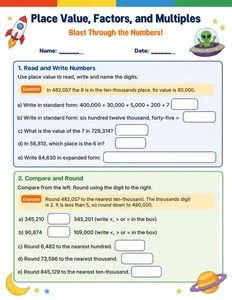
Place value stretches to 1,000,000 this year. Kids read, write, and compare multi-digit numbers, and they round them to any place. In 482,057, the 8 sits in the ten-thousands place.
They also find factor pairs for whole numbers up to 100. The factor pairs of 36 are 1 × 36, 2 × 18, 3 × 12, 4 × 9, and 6 × 6. The first four multiples of 7 are 7, 14, 21, and 28.
Some worksheet sets add roman numerals as a bonus. The Grade 4 overview does not list them, so treat them as enrichment rather than a must-have.
Geometry, Measurement, and Word Problems
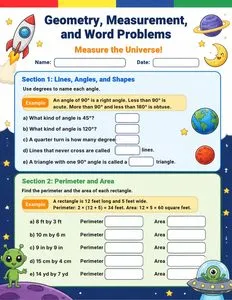
The third critical area covers lines, angles, and shapes. Students measure angles with a protractor and sort shapes by their sides and angles. They also work with perimeter and area.
Sample problem: A rectangle is 12 feet long and 5 feet wide. What are its perimeter and area?
The perimeter is 34 feet, because 2 × (12 + 5) = 34. The area is 60 square feet, because 12 × 5 = 60.
Measurement pages ask kids to convert larger units to smaller ones, such as kilometers to meters or hours to minutes. Word problems pull these topics together.
Here’s one: a school orders 8 boxes of pencils with 144 pencils in each box. The total is 8 × 144 = 1,152 pencils.
Common Mistakes to Watch For
A few errors show up again and again. Spotting them early saves a lot of frustration.
- Skipping the placeholder zero. When a child multiplies by the tens digit, the answer needs a zero in the ones place.
- Adding denominators. Kids often write 1/4 + 1/4 = 2/8. The denominator stays the same, so the answer is 2/4.
- Ignoring remainders. A remainder of 5 left over from 47 ÷ 6 is not just “extra.” The question decides whether to round up, drop it, or write it as a fraction.
- Misreading decimals. As shown above, 0.4 is larger than 0.38, even though 38 is the bigger whole number.
Related: 9 Free Printable Math Worksheets for 1st Grade (and What Each One Teaches)
How to Use Worksheets at Home
Keep sessions short, around 10 to 15 minutes, and stay on one topic at a time. Ask your child to explain one answer out loud, since explaining reveals gaps that a correct answer can hide.
Regular short practice also builds math skills more gently than one long weekend session.
Use 4th grade math review worksheets at the start of the school year and before big tests. Pair those math worksheets with games too.
For more learning resources, see how to teach your child math using Legos and these domino games that teach math.
A Simple Weekly Rhythm
This is a starting point, so adjust it to what your child’s class is covering:
- Monday: multiplication
- Tuesday: division
- Wednesday: fractions
- Thursday: decimals
- Friday: mixed review and a few word problems
Fourth grade math builds on third grade facts and leads into bigger fractions work in fifth grade. Steady, focused practice with fourth grade math worksheets is the surest way to get there.
Related: 12 Free Printable 2nd Grade Math Worksheets (and What Each One Teaches)
Frequently Asked Questions
What math is taught in Grade 4?
Fourth graders work with multi-digit multiplication and division, fractions (equivalents, comparing, adding and subtracting with like denominators), decimals to hundredths, place value to one million, factors and multiples, angles, symmetry, area and perimeter, and measurement conversions.
What is the hardest math in 4th grade?
Most students find fractions hardest, especially comparing fractions with different denominators and multiplying a fraction by a whole number. Multi-digit long division with remainders and multi-step word problems are close behind.
Does Grade 4 have algebra?
Not formal algebra. Fourth graders do pre-algebra thinking: solving word problems with an unknown (like 24 ÷ ? = 6), using a letter for the unknown, finding missing numbers, and extending number and shape patterns that follow a rule.
What are the four rules of decimals?
“Four rules” usually means the four operations with decimals:
Add and subtract: Line up the decimal points, add zeros as needed, calculate, and bring the point straight down.
Multiply: Ignore the points and multiply as whole numbers. Count the decimal places in both factors, then place the point that many places from the right.
Divide: Move the divisor’s decimal point to make it a whole number, shift the dividend’s point the same number of places, then divide, keeping the point directly above.